

Frequently Asked Questions
-
How do research staff members become authorized to order animals within AOPs?
Research staff listed an approved CLICK protocol must also be authorized by the Principal Investigator (PI) to order animals. The PI can assign a proxy to an approved protocol by going to their protocol page within CLICK and clicking on “Assign PI Proxy”. The PI must then select the team member they would like to act as a proxy to authorize animal ordering.
-
How do I include a new funding source on my protocol?
The Department’s Fiscal Officer (FO) is responsible for including the account information in AOPs for billing purposes.
-
How do I ensure I will receive the animals I need in time for my study?
Pending vendor availability, animal orders placed in AOPs by Wednesday at 10:00am will be scheduled for delivery the following week. Delivery date options are listed in the animal ordering section of AOPs. Please plan accordingly to ensure animals are received in time for your study.
-
How can my lab obtain drugs/prescriptions (controlled substances) for our procedures?
For non-controlled substances, please see: Veterinary Medical Supplies
For controlled drugs, the PI is responsible for obtaining a DEA license: see Getting Started with Controlled Substances and Veterinary Medical Supplies
-
I am a new researcher on campus and need to know how to get started on my research?
Contact carinfo@msu.edu for question regarding facilities, animal ordering or contacting a veterinarian for a veterinary consultation. Contact iacuc@msu.edu for questions regarding the protocol review and submission process.
-
How do I get access to the animal housing facility?
You must be on an approved IACUC protocol prior to receiving access to an animal housing facility. Facility orientation is required prior to receiving access to facility. Sharing of MSU ID to access facility is not allowed. Contact carinfo@msu.edu
-
How do I contact a veterinarian during working hours, or after-hours/weekends for animal care concerns?
On the East Lansing Campus
- Weekdays (8:00am-5:00pm) - Email carvets@msu.edu; DL.MSUFarmVet@msu.edu
- Afterhours and weekends - Email carvets@msu.edu, or for emergencies, call (517) 884-8527.
For Grand Rapids Research Center (GRRC)- Weekdays (7:30am-4:00pm) Email DL.CARGRRCVETS@msu.edu
- Afterhours and Weekend – Email carvets@msu.edu, for emergencies, call (517 884-8527)
-
How do I fill out a veterinary health request for an animal to be seen by CAR veterinary staff?
Enter all requested information: PI information, IACUC protocol number, animal information, location of cage, date of observation, and signs of illness.
Initial your documentation.
- Place a red acetate cage card in the cage card holder to notify that cage requires attention.
- Remove the white paper portion (top sheet) of the health request card and place in the facility’s designated location.
- Mark the cage for later ease of assessment
- Place the tan portion of completed health request card in the cage card holder
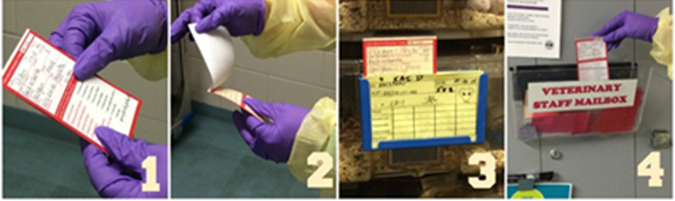
Remember to contact the veterinary staff by email or phone to inform others that this case is to be evaluated by CAR veterinary team members.
-
The animal strain I want to order isn’t in AOPs. What do I do?
Approved animal strains can be added into AOPS by request. If you cannot find the strain you are looking for, please email the strain and stock number to CARinfo@msu.edu.
-
How do I submit rodent cell lines for biological screening?
Cell lines may be submitted to Charles River or IDEXX BioAnalytics. The PI will need to establish an account for sample submission. Charles River provides use of a convenient sample submission on campus and can assist with how to collect samples and shipping of samples for testing using their LTM system:
- Charles River Cell Line sample collection and shipping Instructions (PDF)
- Charles River placing an order in LTM (PDF)
Contact carvets@msu.edu for MSU customer ID and for additional information.
Commonly Requested Links
- Review your approved procedures – Click login
- IG023 Guideline on Rodent Surgery and Medical Records
- IG024 Surgery & Medical Record Guidelines for Non-Rodent Animal Species Used in Biomedical Research
- Import animals from a collaborating institution - Rodent Import Request Form (PDF)
- Export animals to a collaborating institution - Rodent Export Request Form (PDF)
- Ensure repetition of experimental steps and procedures - https://vimeo.com/358069203