

IG017: Storage, Labeling, and Expiration of Multi-dose and Mixed Medical Materials Used in Animals
IACUC Guideline Number: IG017, Approved By: IACUC, Approval Date: 03/12/2026, Version: 7
This guideline outlines the proper labeling, storage, and maintenance of medical substances and materials used in animals to prevent inappropriate use of outdated items. It has been developed to ensure compliance with the Guide for the Care and Use of Laboratory Animals (8th Edition) and the NIH Guidelines on the PHS Policy for the Humane Care and Use of Laboratory Animals.
Definitions:
Expiration Date: Date provided by the manufacturer to indicate when substance is no longer acceptable to use. For expirations provided in Month/Year, the substance expires on the last day of the month listed.
Use by Date: The number of days for which the manufacturer recommends use of a product after it is first accessed (e.g. opened/punctured) or diluted. Also termed beyond use date or in use shelf life.
Medical material: A non-bioactive substance intended for use in the diagnosis, treatment, or prevention of disease. Examples include but are not limited to gauze, sutures, catheters, syringes, needles, etc.
Storage of Substances and Medical Materials:
Substances and medical materials are to be stored in accordance with the manufacturer guidelines, or under conditions described in performance standard literature (e.g., at specific temperatures/refrigerated, protected from light, in glass container, etc.).
Before each use, products should be visually examined for any changes; presence of precipitation, color change, or change in homogeneity indicate that a product may no longer be safe to use or effective even if it is not expired.
Expired Substances and Materials:
Expired substances and medical materials, including euthanasia agents, have unknown purity, potency, stability, and efficacy. Therefore, their use in survival surgical procedures is not consistent with adequate veterinary care. It is NEVER acceptable to use expired anesthetics, analgesics or euthanasia drugs in an animal, regardless of whether the procedure will be survival or terminal. It is the responsibility of the Principal Investigator (PI) to institute adequate inventory and laboratory management procedures to ensure that expired drugs and medical materials are promptly identified and properly disposed of. All expired medical materials must:
- Be stored separately from non-expired medical materials.
- Be clearly labeled: “For use in terminal procedures only”.
For substance dilutions, preparations, or reconstitutions, prepared using sterile technique and under proper storage conditions, an expiration date of six (6) months from the date of preparation is recommended, unless otherwise scientifically justified in the animal protocol. If any single component of the reconstituted substance has an earlier expiration date, that date should be used instead.
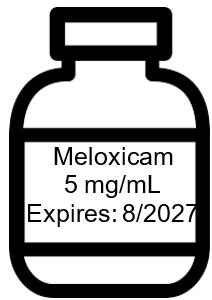
Such preparations should be labeled with the substance name(s), drug concentration(s), and expiration date as soon as they are prepared (see example). An item is considered expired the day after the month or date indicated on the label. (Example: Item labeled Aug. 2027 would be considered expired on Sept. 1, 2027.) Expiration dates must be verified prior to all surgical procedures to ensure appropriate anesthesia and euthanasia. Per veterinary practice standards, the use of expired medical materials or substances (e.g., drugs, fluids, sutures, anesthetics, sedatives, analgesics) during any survival surgical procedure is unacceptable.
Expired materials (e.g., catheters, fluid lines, sutures) may be used in nonsurvival procedures when the animal is anesthetized and euthanized without recovery. These terminal procedures must not adversely affect the animal’s well-being or compromise scientific validity. Liquids, solutions, or drugs (e.g. analgesics, sedatives, anesthetics, fluids, or euthanasia solutions) CANNOT be used in non-survival surgery.
Use-By-Date:
Many medical products have both a standard “Expiration Date” and a “Use-By-Date” (i.e., “Beyond Use Date”, “In Use Shelf Life”) printed on the label or package.
- Recommendations for use-by dates are primarily related to maintaining the integrity of the container/rubber stopper. It is imperative that proper storage and handling is monitored as described by the manufacturer (see storage guidelines above). When the integrity of the container/stopper is compromised due to improper handling, the product should be disposed of promptly.
- When manufacturer guidelines for storage and use are followed (e.g. use of appropriate needle size for puncture, only penetrated with sterile needles, etc.), and the container and product are visibly inspected for appropriate condition prior to use, the labeled expiration date may be followed.
Proper Disposal of Expired Drugs:
Whether hazardous or non-hazardous, all expired or unwanted drugs are to be disposed of according to MSU Environmental Health & Safety (EHS) guidelines. Guidance for specific types of waste can be found at MSU Environmental Health & Safety - Waste. For additional questions, please contact EHS at 517-355-0153 (or ehs.msu.edu)
References
- Federation of Animal Science Societies. Guide for the Care and Use of Agricultural Animals in Research and Teaching. 4th Champaign, IL: Federation of Animal Science Societies, 2020.
- Green CJ, al. “Animal Anesthesia.” London: Laboratory Animals Ltd, 1979. p79.
- National Research Council. Guide for the Care and Use of Laboratory Animals. 8th Ed.
- Washington, DC: National Academies Press, 2011.
- Public Health Service Policy on the Humane Care and Use of Laboratory Animals, Section IV., OLA
- USDA APHIS Animal Care. Animal Welfare Act and Animal Welfare Regulations. 2008.
- Taylor, al. “Beyond-use dating of extemporaneously compounded ketamine, acepromazine, and xylazine: safety, stability, and efficacy over time.” JAALAS. 2009 48(6): 718-726.
- Xu, Jiajie J., Renner, Deanna M., & Lester, Patrick A. (2021). Strength and sterility of stock and diluted carprofen over time. Journal of the American Association for Laboratory Animal Science, 60(4), 470-474. doi: 10.30802/AALAS-JAALAS-20-000102.
- DenHerder, Johnathan M., Reed, Ralph L., Sargent, Jennifer L., Bobe, Gerd, Stevens, Jan F., & Diggs, Helen E. (2017). Effects of time and storage conditions on the chemical and microbiologic stability of diluted buprenorphine for injection. Journal of the American Association for Laboratory Animal Science, 56(4), 457-461.